In tunnel safety, detecting an incident is only the beginning.
Modern road tunnels are becoming increasingly complex environments, where operators are required to supervise multiple infrastructures simultaneously, manage growing traffic volumes and react within seconds to potentially critical situations. In this context, Automatic Incident Detection (AID) systems are becoming an essential component of tunnel operation and traffic safety.
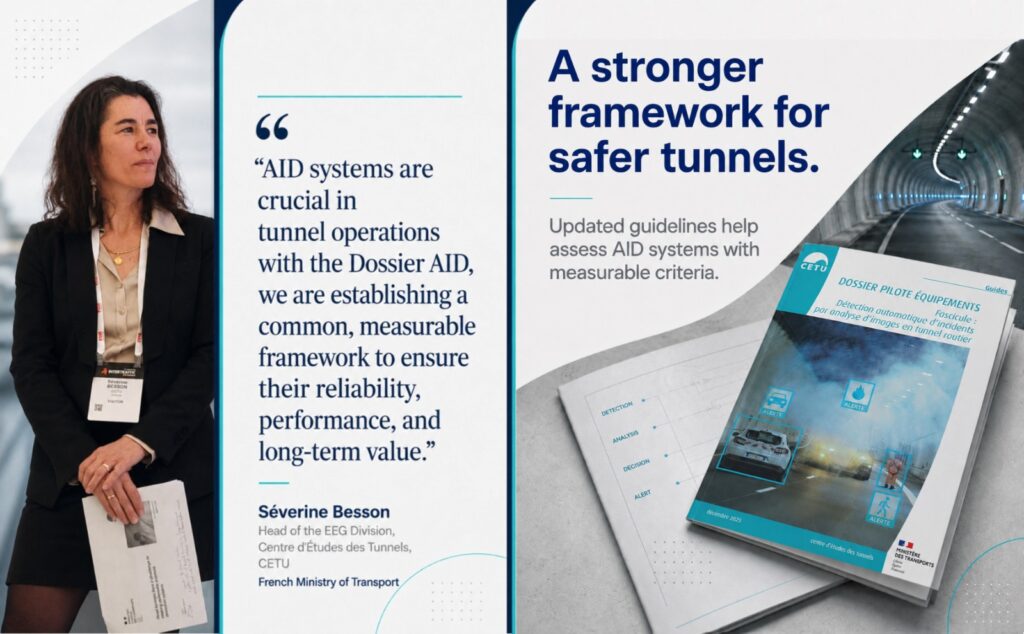
But deploying an AID system is not enough.
Its real value depends on something far more demanding: the ability to guarantee reliable, measurable and sustainable performance over time.
This was one of the central themes discussed during the Intertraffic 2026 Spotlight Session where Séverine Besson from CETU (Centre d’Études des Tunnels), presented the new Dossier AID, an important technical reference dedicated to the design, implementation, assessment, validation and maintenance of Automatic Incident Detection systems in road tunnels.
Beyond detection: understanding real AID performance
One of the most important messages emerging from the session is that AID performance cannot be reduced to a simple detection percentage.
A truly reliable system must combine several critical dimensions simultaneously as fast and consistent incident detection times, controlled false alarm rates, stability under varying traffic conditions, robustness in complex environmental scenarios, long-term maintainability and operational reliability throughout the system lifecycle
This represents a major shift in perspective.
Historically, many tunnel projects focused primarily on whether a system was technically capable of detecting stopped vehicles, pedestrians, smoke or wrong-way driving events. Today, the challenge is broader: operators and authorities need to understand how reliably these systems perform every day, under real operational conditions, and over many years of service.
Why validation frameworks are becoming essential
As tunnel infrastructures evolve, so do the technologies supporting them.
Video analytics, thermal imaging, AI-driven monitoring and advanced image processing are rapidly increasing the capabilities of AID platforms. However, technological sophistication alone does not automatically translate into safety performance.
Without clear evaluation methodologies, measurable indicators and standardized validation procedures, comparing systems or assessing operational effectiveness becomes extremely difficult.
The CETU Dossier AID addresses precisely this issue by proposing a stronger methodological framework based on:
- Objective performance indicators
- Realistic testing procedures
- Continuous monitoring methodologies
- Lifecycle-oriented maintenance approaches
- Data-driven validation processes
Importantly, the document emphasizes that system evaluation should not stop after commissioning.
Performance verification must continue throughout the operational life of the infrastructure, ensuring that degradation, environmental changes, camera aging, software updates or traffic evolution do not progressively reduce system effectiveness.
The role of AI in future tunnel operations
Artificial intelligence is increasingly influencing the future of tunnel monitoring.
Advanced AI-based systems can now improve object classification, reduce false positives, optimize incident recognition and support operators with more contextual information. Yet this evolution also raises important questions regarding transparency, reliability and performance accountability.
For tunnel operators and road authorities, innovation alone is not enough.
The real objective is transforming innovation into measurable and verifiable safety outcomes.
This is why structured technical references such as the CETU Dossier AID are becoming increasingly important for the ITS and tunnel safety ecosystem. They help create a common language between operators, integrators, designers, authorities and technology providers while supporting more objective decision-making processes.
A stronger foundation for tunnel safety
The new Dossier AID provides valuable guidance for all stakeholders involved in tunnel monitoring and road safety projects.
Its contribution goes beyond technology selection: it establishes a more rigorous framework for understanding what effective AID performance truly means and how it should be evaluated over time.
As tunnels become smarter and mobility ecosystems more interconnected, the importance of reliable incident detection systems will only continue to grow.
And in safety-critical infrastructures, reliability must always be demonstrated, not assumed.
For those interested in learning more, the Dossier AID is available on the CETU portal (please note that the current link refers to the French version; the English version will be available soon):
https://www.cetu.developpement-durable.gouv.fr/un-nouveau-guide-sur-la-detection-automatique-d-a1842.html?lang=en